When the Title Is Gone
Why the leaders we remember are rarely remembered for their position

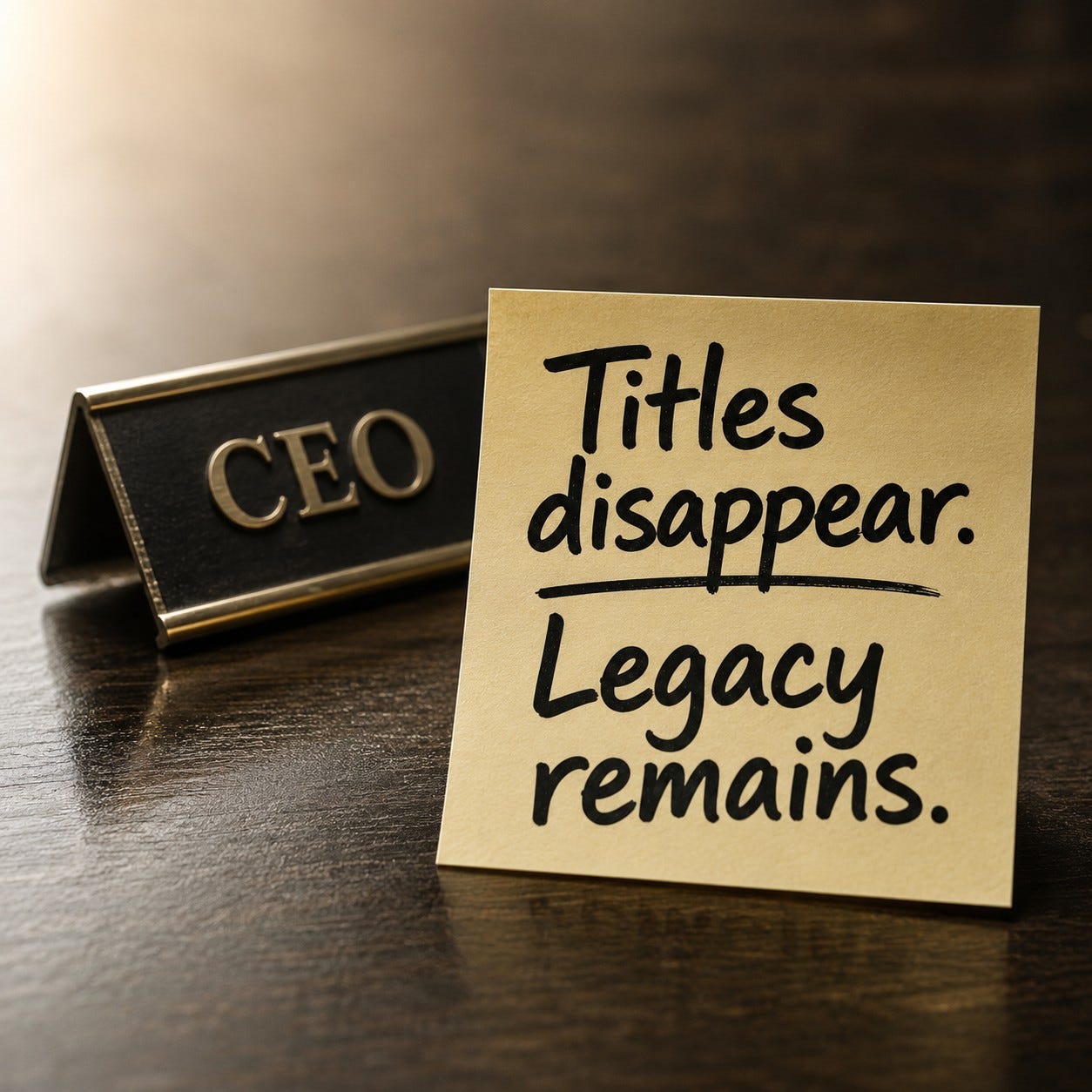
Most leaders overestimate the importance of their title.
Not because titles don’t matter.
They do.
Titles establish accountability. They clarify decision-making. They give organizations structure.
But they are temporary.
Every title eventually belongs to someone else.
Every office is occupied by a different leader.
Every organizational chart is rewritten.
The question isn’t whether your title will disappear.
It will.
The question is what remains after it does.
For many years, I believed leadership was largely about responsibility.
Making difficult decisions.
Setting direction.
Delivering results.
Those responsibilities matter. They always will.
But over time, I realized something else.
People rarely remember the organizational chart.
They remember the experience of working with the person who occupied it.
They remember whether they felt trusted.
Whether they felt respected.
Whether they grew.
Whether someone believed in them before they believed in themselves.
Authority and legacy are often treated as though they are the same thing.
They aren’t.
Authority comes from a position.
Legacy comes from behavior.
One is assigned.
The other is earned.
That distinction becomes increasingly important as organizations continue to evolve.
Healthcare is changing rapidly. Artificial intelligence is reshaping workflows. Decisions are being informed by more data than ever before. Entire operating models are being redesigned.
Yet none of those changes alter one fundamental truth.
People still choose whether to trust their leaders.
Technology can improve decisions.
It cannot replace character.
Artificial intelligence can help identify patterns.
It cannot decide how people should be treated.
It can optimize a process.
It cannot create a culture.
Those responsibilities still belong to leaders.
And they become most visible in ordinary moments.
A difficult conversation.
A mistake that needs to be owned.
A team member who needs encouragement rather than criticism.
A decision where doing the right thing is more difficult than doing the convenient thing.
These moments rarely appear in annual reports.
Yet they become the stories people remember years later.
When someone reflects on the best leader they ever worked for, they rarely begin by describing that person’s title.
They describe how that leader made them feel.
They remember being challenged without being diminished.
They remember being held accountable while still feeling supported.
They remember someone who remained steady when circumstances were uncertain.
Long after quarterly results have been forgotten, those experiences remain.
Perhaps that is the real measure of leadership.
Not whether people respected your position.
But whether they respected you after the position was gone.
Every leader eventually reaches a day when the title no longer appears beside their name.
What continues beyond that moment is not authority.
It is reputation.
And reputation is built one interaction at a time.
Titles are temporary.
The way we treat people becomes our legacy.
If there is one question worth asking at the end of each day, perhaps it is this:
If my title disappeared tomorrow, what story would people tell about working with me?
Because in the end, that story is the leadership we leave behind.